
How to Create and Send a Voice Message Campaign
This guide walks you through how to create and send a Voice Message Campaign from start to finish in Recrevio.
We cover everything needed to send a Voice campaign, including audience selection, message settings, and sending options.
Before you start (required)
To send SMS, WhatsApp, or Voice messages, you must connect Twilio first.
👉 See: Twilio Integration on how to setup your Twilio Integration in Recrevio
👉 See the separate articles on How to Analyze Campaign Performance for full details on how to measure and analyze Voice campaigns.
Step 1: Go to Create Campaign
Navigate to: Marketing > Campaigns > Create Campaign
You’ll start by selecting the campaign flow.
Step 2: Select campaign flow
Choose the channel you want to use:

- Email Campaign – send email campaigns to your subscribers
- SMS / WhatsApp / Voice Campaign – send message campaigns to your subscribers
Click SMS / WhatsApp / Voice Campaign to continue.
Step 3: Name your campaign
Enter a Campaign Name.
This name is for internal use only and helps you identify the campaign later in lists and analytics.

Click Next to continue.
Step 4: Select campaign type (SMS, WhatsApp, or Voice)
Choose the type of message campaign you want to create.

- SMS Campaign
- WhatsApp Campaign
- Voice Campaign
Choose Voice Campaign and click Next to continue.
Step 5: Select recipients (lists & segments)
In the Recipients step, choose who will receive your campaign.

You can select:
Lists
Static groups of subscribers (e.g. “Newsletter”, “Customers”, “Event signups”).
Segments
Dynamic audiences based on filters (e.g. “Active members”, “Clicked last 30 days”).
For each list or segment, you can:
- Include it (send to these people)
- Exclude it (remove these people from the final audience)
You’ll see the total recipient count update as you select recipients.
Click Next to continue.
Step 6: Campaign summary & message settings
This step lets you review key settings and write your message.
Campaign Type
This shows the channel selected for the campaign.
The campaign type determines:
- How the message is delivered (SMS, WhatsApp, or Voice)
- Which message editor and options are available
- Which Twilio services are used in the background
The type is set earlier in the campaign flow and cannot be changed at this stage. You can go back and change the Campaign Type at the Type step in the Setup process.
Sales tracking (optional)
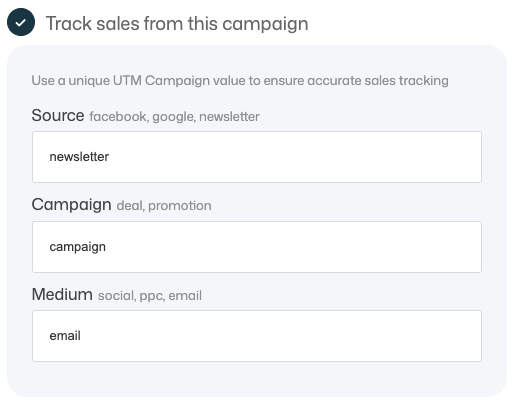
You can enable Track sales from this campaign.
When enabled, you can define:
- Source (e.g. newsletter, facebook, google)
- Campaign (e.g. launch, deal, promotion)
- Medium (e.g. email, social, ppc)
These values are used to generate UTM tracking links and connect email clicks to sales data.
👉 See the separate article on How to Analyze Campaign Performance for full details on how to measure and analyze Voice campaigns.
Recipients
The Recipients section lets you review who will receive the campaign before sending.
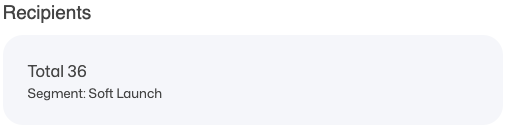
Here you can see:
- The total number of recipients
- Which list or segment the campaign is being sent to
If the recipient count doesn’t look correct, you can go back to the Recipients step to adjust your list or segment selection before sending the campaign.
Voice Campaign — language, speech engine & audio playback
A Voice Campaign lets you send automated voice calls to your audience.
You can choose between:
- Text-to-speech – the system reads your written message aloud using a selected language and voice, or
- Audio playback – play a pre-recorded audio file that you upload or link to.
This gives you flexibility to either quickly generate voice messages or deliver a fully custom, recorded message in your own voice.
Configure voice settings
In the Voice section, start by choosing how your message should be delivered. If you want the system to read your message automatically, configure the following settings.
-
Language locale
Select the language and accent used for speech output.
- A wide range of languages and regional accents are offered, such as multiple variants of English, as well as commonly used European and international languages. The available options depend on the selected speech engine and may vary by provider.
-
Choose a locale that best matches your audience to ensure natural pronunciation.
Speech engine / voice
Select which voice engine and voice style should be used. Available options are typically grouped as:
-
Basic (free)
Simple system voices (e.g. Man – Male, Woman – Female).
-
Standard (charges apply)
Expanded voice options, often including standard provider voices and Amazon Polly voices.
-
Premium (charges apply)
High-quality neural voices with more natural intonation and expression (e.g. Polly Neural voices).
Write the voice message
Type the script you want the system to read aloud during the call.
This text will be converted to speech using your selected language and voice.
Play a recorded audio file (attach audio)
If you prefer to use your own recorded message, you can attach an audio file instead of using text-to-speech.
- Click Attach
- Upload an audio file or provide a URL to an audio file
- The attached audio will be played to recipients
This option is ideal if you want:
- A personal message in your own voice
- Professionally recorded audio
- Full control over tone, pacing, and pronunciation
When an audio file is attached, the system will play the recording instead of reading text aloud.
Voice message actions
While creating your voice message, you will see the following actions:
-
Add tag
Apply tags to recipients or associate metadata with the campaign.
-
Attach
Upload or link an audio file to be played during the call.
-
Send Test
Send a test call to verify audio quality, voice settings, and message content before sending to your full audience.
Once your voice message is configured and tested, click Next to continue to the sending step.
Step 7: Send or schedule the campaign
In the final step, choose when to send your campaign:
Send options
- Draft – save without sending
- Now – send immediately
- Later – schedule for a specific date and time
When everything looks correct, click Send Campaign.
What happens next?
- All campaigns (sent or draft) appear in Marketing > Campaigns
- Drafts remain editable and can be resumed anytime
- Performance data becomes available after sending
Summary
Creating a message campaign follows these steps:
- Go to Marketing > Campaigns > Create Campaign
- Select Campaign Flow (SMS, WhatsApp or Voice)
- Name the campaign
- Select campaign type: Voice
- Select recipients (lists/segments + include/exclude)
- Review settings, write your message and manage templates
- Send now, later, or save as draft